
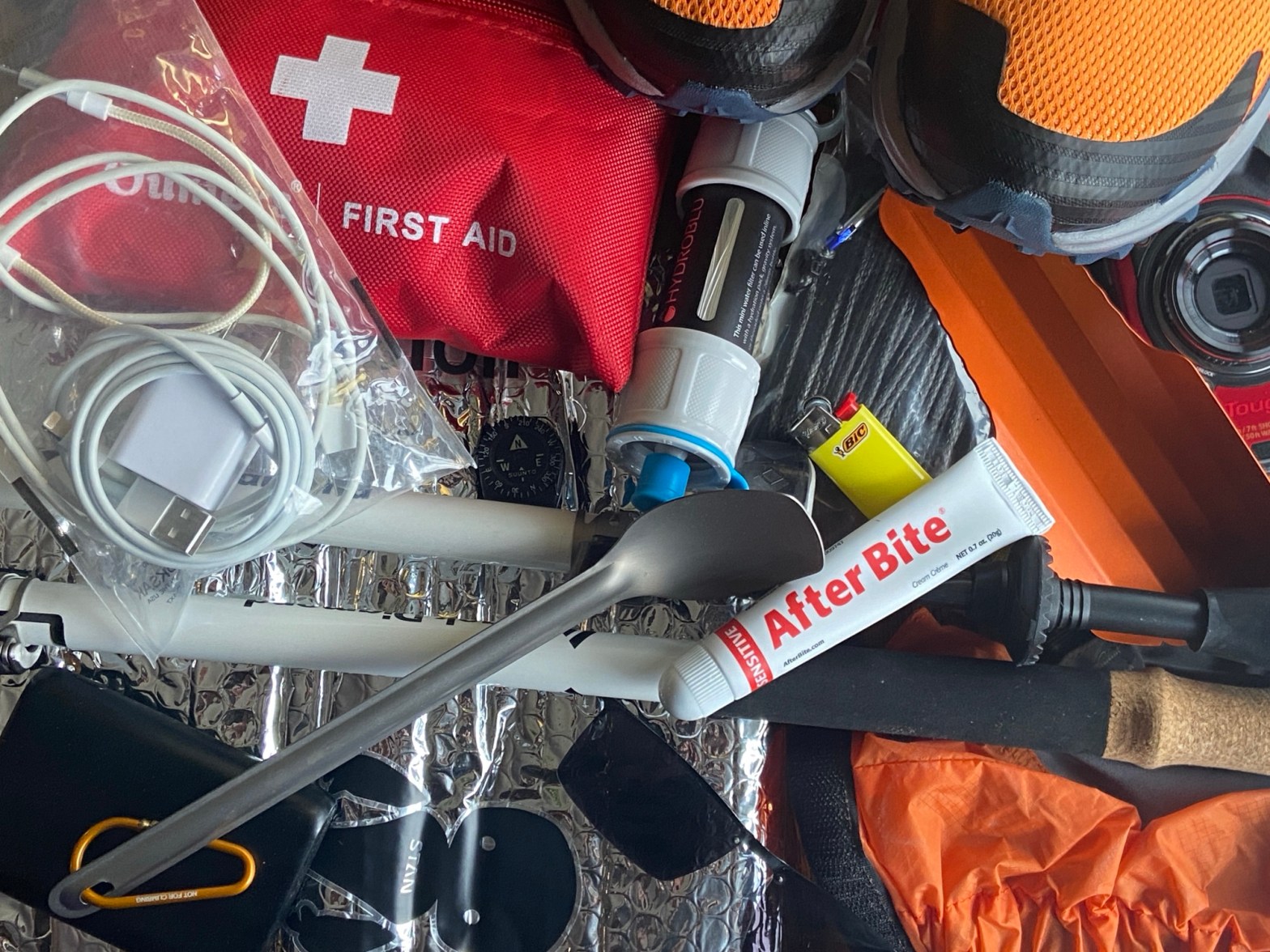
As sure as a Star Wars movie has a Death Star, as sure as a NASCAR race will have a crash, no self respecting thru-hiking blog is complete without at least one post devoted to gear.
Inquiring minds want to know, and hikers are more than willing to share. Hikers love to talk about their gear choices. They share this trait with photographers and it is so prevalent in both circles that I’m often surprised they ever find time to actually head into the wilderness or snap a shutter.
Tent, hammock or tarp? Hiking boots or trail runners? Gear is an omnipresent factor throughout the logistics planning needed to carry out an endeavour such as thru-hiking the Appalachian Trail. Gearing up marks a step closer towards that starting line, a physical, albeit consumer-centric, commitment of blood and treasure that leans directly towards getting on trail.
There is always a magical time in any thru-hiker’s adventure when one moves from talking about hiking the trail to starting the early stages of ‘gearing up.’ This is often the first bud of life in any thru-hike. This is the moment where dreams move to concrete actions. Here the book is laid down the map opened, and the first considerations of where, when and how begin to take shape.
There are so many decisions to be made. Carry a stove or save weight and eat only cold food? Should I pack out an umbrella? Do I want a camera or will my phone be enough?
All this is why hikers trade gear tips so frequently and so faithfully. It is essential to be well informed, before you set out, about the exact clothing and equipment needed for the terrain you will cover and the time of year you will cover it.
Finding suitable gear is one of the best scavenger hunts you will ever take part in. There are things to find like tiny cookstoves and specialty lightweight air mattresses. There are things to make like bear hang kits. There are things to modify like cutting the handle off your toothbrush, or fixing your water bottle to your backpack’s shoulder strap at the perfect angle and height. And there are things that require all of the above, like your water filtration setup.
Finding that perfect piece of kit could make my whole week. When you are still 2-3 years away from starting your hike, almost anything that helps you feel closer to the trail will brighten your spirits. A lightweight North Face rain jacket at TJ Maxx for 25% of full price is as good a reason to celebrate as anything. “I’m practically at Katahdin!”
Before deciding on which brand to buy, one must figure out what to items buy. Making bad gear decisions has real consequences on trail. Comfort and safety are directly impacted by the choices made before setting off. Gear that’s too heavy, not warm enough, not waterproof, doesn’t dry fast enough, or doesn’t ventilate adequately can turn a great day in the outdoors, into a nightmare. Nor is there a perfect set of hiking gear. What works on the Pacific Crest Trail (PCT) is not the same gear for the Continental Divide Trail (CDT) or the AT. Since a thru-hike can take four to six months, and cover thousands of miles, gear often needs to be swapped out for different sections of a single long distance adventure.
Sure, some gear is found easily at Costco or on Amazon* but many more items are so specialized they will require some hunting, especially if you are weight conscious.
My approach was to set a target ‘base pack weight’ ** and work to reach that goal. The goal I settled on was 20 lbs. (9 kg). With food and water added I would still be well under 30 lbs. (11.3 kg). This, for me, is manageable.
I already had a lot gear from my days as a canoe camper. I thought I would only need a few items to round out my existing kit. My yellow external frame 1970’s era backpack was never very waterproof and would have saddled me with a trail name like ‘Retro’ or ‘Oldskool’ and was, therefore, never an option.*** Otherwise, I believed I had a lot of perfectly serviceable gear to move myself down the trail. Then, I weighed it.
Both mountain hiking and canoe camping are a lot of fun, and both occur in the great outdoors so there are a lot of similarities. But, the ‘elephant-in-the-room’ difference, I swiftly found out, was that a canoe can hold hundreds of pounds of gear and a backpack can’t.
Going for a weekend in a canoe? Bring a case of beer. The supply store didn’t have cans, only bottles? No problem, toss them in. Steaks, corn on the cob, frying pan? Welcome to the Grumman aluminum canoe which will whisk these supplies gracefully across the water to your secluded camping paradise with minimal effort. Don’t burden yourself with difficult gear decisions, just toss it in the canoe. Better safe than sorry. You can even bring a date! Clearly the canoe camping gear was too heavy, and I would need to purchase at least some new stuff.
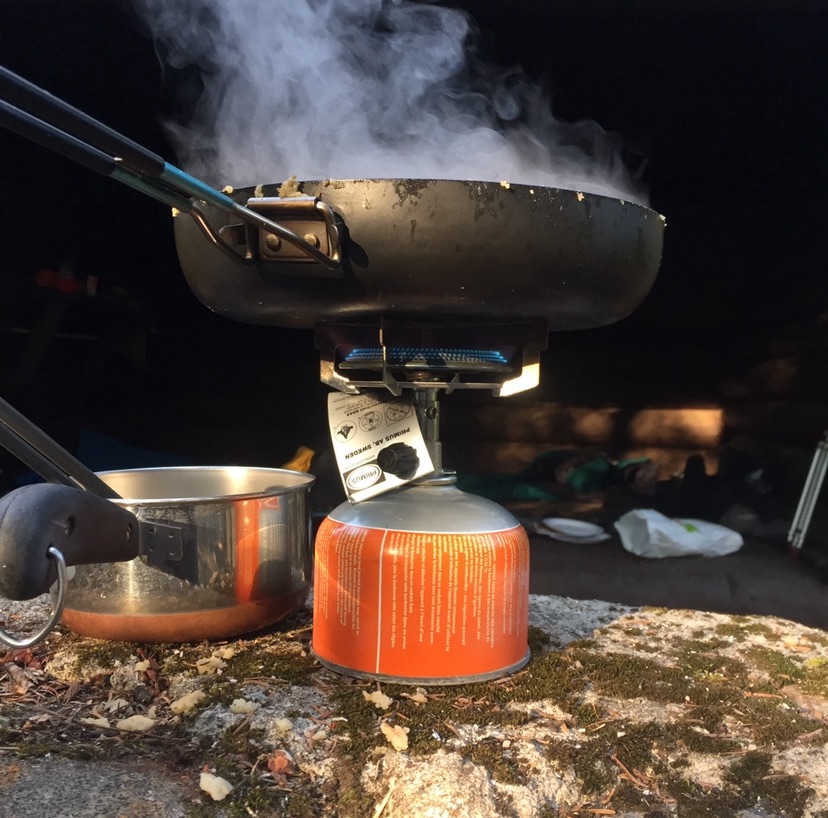
My gear-up odyssey began with the camp kitchen, mostly because I thought I already had pretty good equipment. I had a Jetboil, enamel cups, and aluminum pots. I had a lightweight frying pan. After only minimal research I found out a Jetboil is a full blown luxury item. Even warm meals on the trail is a luxury as some prefer to eschew a stove and fuel altogether and only cold soak their dehydrated sustenance.
The weight of this legacy gear started to add up fast. My perfectly good enamel coffee cup weighs three times what a titanium one does. Of course, I could bring it anyway and save the $30-$40 for a lightweight one, but you soon realize you are faced with the same dilemma for each and every item in your pack!
In the end, I needed all new kitchen gear. Enamel needed to be Titanium. The 340 gram Jetboil should be swapped for a 100 gram BRS stove. My lightweight frying pan was very ‘not recommended.’ Nobody carries one. In fact, there isn’t any frying pan that is even close to making onto any expert’s AT gear list.
Setting the camp kitchen research aside, it was time to look at everything at once. More research revealed that entire categories of gear you might think of as essential are not only non-essential, but not recommended at all. In fact, there is very little crossover between ‘essential’ and ‘not recommended.’ If it isn’t the former, it’s the latter!
I changed my approach from making numerous ‘gear weight exceptions’ to a zero tolerance approach. But, I was still ‘overweight.’
The next step was to drop things. Items I would previously have considered totally essential were crossed off my list. I have no soap. Of course, I will find soap in town, but when I am walking the trail, there will be no soap in my pack.
If what I had is no good, then what IS good? It was time to do some deeeeep research!
Don’t pack out “anything that processes wood” is how one YouTuber aptly summed up gear choices like camp saws and axes. I thought I was being economical by bringing only, a ring and wire saw, but after considering the matter more closely, realized I would likely never even need it.
I agonized for weeks about whether to buy a down or synthetic sleeping bag. Down is warmer, but also performs poorly if wet. There are many other considerations. I chose down. I bought my bag soon after. A week later, I watched legendary hiker Andrew Skurkas video from google HQ where he casually mentioned that down bags pick up moisture from the humid air, not so much from direct rainfall. His choice for the humid AT would be: synthetic. #%€%! Deep breaths. It’s not a disaster. But I must take extra time and care to keep my bag dry at hostel and hotel stops. On the plus side, if I ever do the drier Pacific Crest Trail (PCT) I’m all set with a primo down bag.
Some ultra lightweight hiker-types take no first aid kit, then brag about how amazing they are for having a 12 lbs. pack. I refer to this as ‘lightweight by proxy.’ It is really quite simple to go into the woods less than prepared then ‘Yogi’ resources from hikers who did prepare. I’m only really turned off by this if the same hiker that yogis food or needs bandages in an emergency, also brags about their super lightweight gear setup.
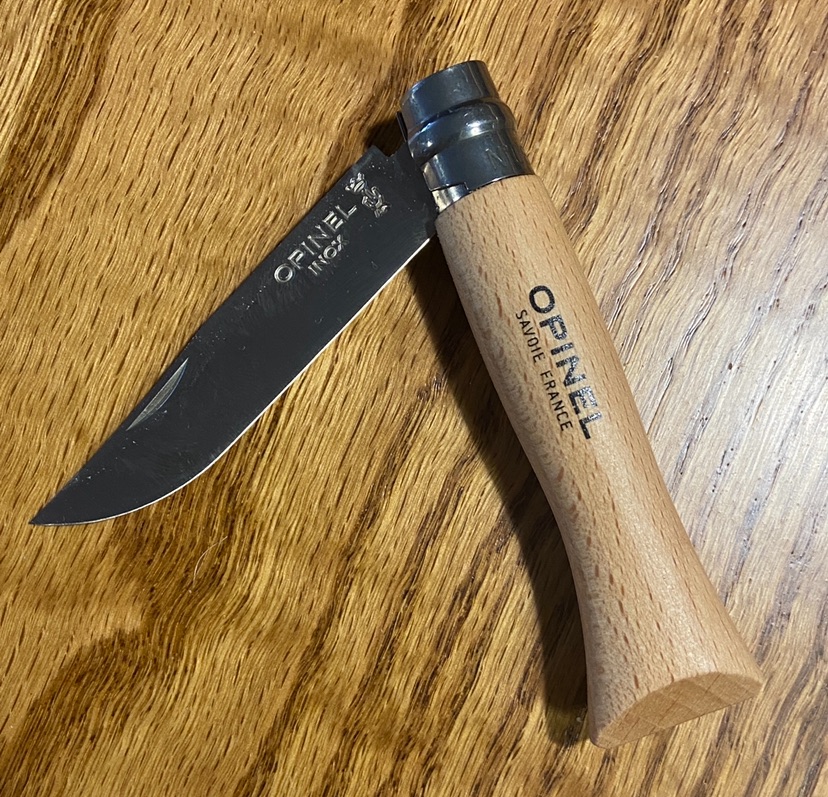
What remained of my canoe camping gear, after weigh-in and re-evaluation of necessity, was a solitary lightweight buck folding knife my brother gave me years ago and an army surplus can opener. I later replaced the knife with an even lighter Opinel wooden handled one, albeit likely less durable, making the 4-gram can opener the only item from my vast stock of canoe camping gear to make the cut.
After this reality check, it should be noted that I could still have made an alcohol stove from an empty tin of Fancy Feast cat food with some air holes added with a hole punch. My kitchen weight would have dropped further still, but I’m not fond of the invisible flame that comes with alcohol stoves.
The gear you do include must pass a few rigorous tests to include it in the bag. Primarily, it must be ‘essential.’ Various luxury items are included by almost everybody, but doing so comes with risks. Any added weight in your bag will make crossing mountains tougher. If you fall, you will fall harder with a heavier pack. The miles of extra weight add up, taking a toll your the backpack contact points (shoulders and hips) and on the knees, ankles and feet.
Another big decision was tent, hammock, or tarp? I chose a tent. For me this was an easy decision because of a few factors. The first is that I can sleep pretty much anywhere. Hammocks are mostly favored by people who have difficulty sleeping on hard ground. But they require 2 anchor points (usually trees) which are not alway present on the Appalachian Trail, especially in Maine or at higher elevations where the trees are small and fragile. A tarp system, while very lightweight and minimalist, does not provide the insect protection I feel I will need in Vermont and New Hampshire particularly. Nonetheless, many people successfully hike the Appalachian Trail using both hammocks and tarp systems. Choosing those other systems is completely legitimate, albeit not the best choice for me. The Zpacks Duplex 2-person tent is a very frequent choice for this journey, and at only 1.4 lbs. (652 grams) AFTER I added some ‘fun flags,’ I am quite comfortable with my shelter choice.
My gigantic luxury item is my camera gear. While a smartphone is not cosidered a luxury, it comes with what most people would consider a fully adequate camera and video recorder. So any extra camera and accompanying gear must be considered unessential and therefore ‘luxurious.’
Gear must also be reliable and easily field repairable. Cheap gear, while often lightweight, can fail when you need it most. Read reviews, and stick to brands and even specific models that more experienced hikers have reported are durable and reliable. I found a $3 flashlight that was bright and weighed only a gram or two more than the usual models favored by thru-hikers. I included in my gear only to have the switch fail on my first test hike. I later decided a headlamp would be enough illumination and dropped even the recommended mini flashlight.
After months of uber-researched online shopping, gear modification and strategic trimming of list items I was able to get a pack to below my target weight of 20 lbs (9 kg). I actually did so well that I got my weight down to 16.1 lbs (7.3 kg). Now faced with the choice of lowering my pack target or adding back weight I chose the latter.
Mostly, I swapped my super-lightweight Zpacks Arcblast for a much heavier but more durable Osprey brand pack that I have always found very comfortable and better fitting. It also had far more places to attach items on the outside of the pack. I added a couple of luxury items, like a second pair of underwear and an mp3 player. At present, my base pack weight sits at 21.1 lbs (9.57 kg).
Here is the full list of gear I will depart with on April 9 and the accompanying weight in grams:
€ denotes an essential item
£ denotes a luxury item
The split between luxury items and essential items is not perfect. Sometimes a premium version of an essential item is partly luxurious, while items deemed luxurious are partly essential. Hopefully the 2 errors cancel each other out.
Big Three
Backpack: Osprey Kestrel 48 litre € (1,588 grams)
Tent and storage bag: Z-packs Duplex 2-person € (652 grams)
Sleeping bag / compression sack: REI € (957 grams)
Clothing
1 pair of briefs € (76 grams)
1 pair long underwear £ (201 grams)
1 pair of socks € (61 grams)
1 pair of jogging shorts € (99 grams)
1 pair of insulated yoga pants € (299 grams)
1 polyester t-shirt € (163 grams)
1 puffy jacket w/ compression sack € (407 grams)
Arc’teryx mittens € (65 grams)
1 headband € (17 grams)
1 buff € (41 grams)
Rain jacket w/ bag € (220 grams)
Attached to the backpack
Crocs camp shoes € (302 grams)
Poop shovel € (19 grams)
Shoulder pouch with phone, phone ziploc, passport, wallet and sunglasses clip-on € (406 grams)
Water bottle holder € (70 grams)
MP3 player and pouch £ (78 grams)
Suunto compass £ (4 grams)
Emergency whistle £ (8 grams)
2 Smartwater bottles € (86 grams)
CNOC bag canteen £ (76 grams)
Tent footprint € (197 grams)
Stretching elastic £ (90 grams)
Dogtags £ (16 grams)
EMS thermometer £ (6 grams)
Rain cover € (143 grams)
Towel € (33 grams)
Sunscreen pouch € (70 grams)
10 litre expansion sack € (82 grams)
Kitchen
Camp kit dyneema bag € (14 grams)
Can opener £ (4 grams)
Mini Bic lighter € (11 grams)
Toaks titanium pot € (76 grams)
Titanium pot lid £ (22 grams)
Titanium pot cosy £ (14 grams)
BRS Stove € (28 grams)
Gas cannister for BSR € (167 grams)
Titanium long spoon € (17 grams)
Oven mitt (finger) £ (12 grams)
Mini scour pads £ (5 grams)
Powder spoon £ (1 gram)
Food Bag
The food bag actually contains anything scented including food (except toilet paper).
Bag weight € (46 grams)
Bear hang kit € (60 grams)
Toothbrush € (6 grams)
Toothpaste € (26 grams)
Mirror £ (25 grams)
Ziploc spares € (121 grams)
Foot powder container £ (30 grams)
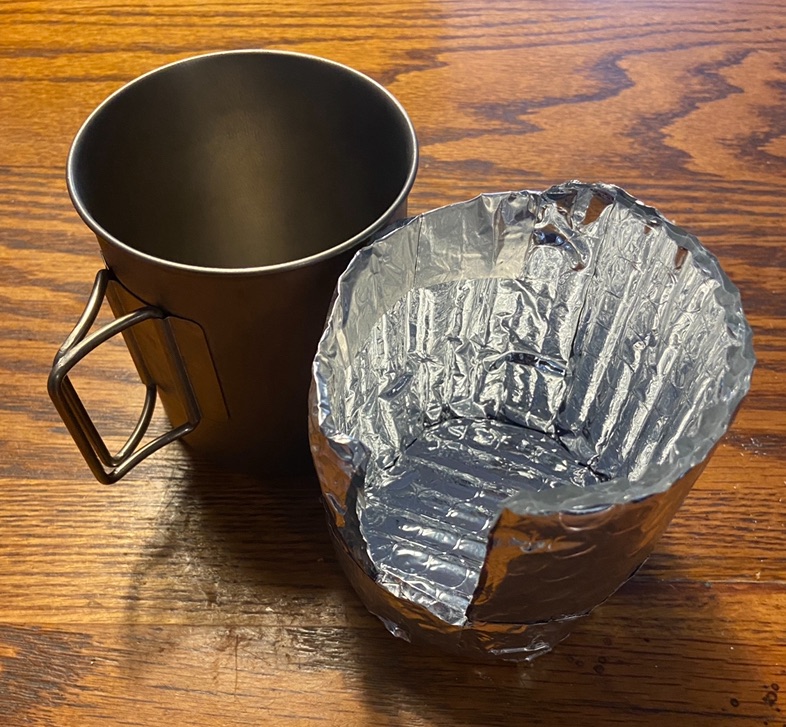
Reflectix Cozy € (59 grams)
Prescription Medication € (57 grams)
After Bug Bite Cream € (23 grams)
Toolkit € (81 grams)
Toolkit contents:
Needle / thread kit, safety pins, space pen, flammable sticks, tie-wraps, Thermarest air mattress repair kit, pencil sharpener, aluminum threaded rivets, 2x spare carabiners, dental floss for thread, spare water bottle nipple, mini-screwdriver for Black Diamond trekking pole maintenance.
First aid kit total € (139 grams)
First aid kit contents: gauze, gauze tape, assortment of bandages, sterile gauze swab, blister cushion, alcohol pad, iodine prep pad, quick first aid guide, moleskin, triangular bandage, large tick remover, small tick remover, finger cots.
Electronics bag € (83 grams)
Electronic bag contents:
Waterproof bag, wall wart, usb cable, lightning cable, usb-c cable, micro-usb cable, micro-adaptors etc…
Lavalier microphone kit £ (36 grams)
Other pack contents
Inflatable pillow £ (88 grams)
Air mattress € (358 grams)
Titanium tent pegs 8x € (51 grams)
Spare trekking pole tips £ (17 grams)
Zip-loc Garbage Bag € (13 grams)
Bugnet € (20 grams)
Hydration system € (96 grams)
Backup filter £ (54 grams)
Headlamp w/ sack € (89 grams)
Backup battery w/USB-C cord (160 grams)
1 Roll of toilet paper w/ Ziploc € (202 grams)
Stretching Elastic w/ Ziploc £ (89 grams)
Foot massage ball € (80 grams)
Spare backpack liners € (60 grams)****
Improvised lanyard pouch € (31 grams)
Photography equipment
Olympus Tough £ (255 grams)
200/400mm lens £ (178 grams)
Neutral density filter w/ case £ (40 grams)
Polarizing filter w/ case £ (42 grams)
Extra batteries 2x £ (47 grams)
Tripod for camera or phone £ (71 grams)
USB charging cable for Olympus £ (4 grams)
Lenscaps and adaptors £ (12 grams)
Spare SD card £ (2 grams)
Gear not included in my pack weight
(Some gear is not included in my base pack weight because it is assumed I am either wearing it or carrying it)
1 Pair of trail runners € (672 grams)
Black Diamond hiking poles € (560 grams)
1 pair of socks € (61 grams)
1 pair of briefs € (76 grams)
1 pair of trousers € (336 grams)
1 OR sun hoodie € (134 grams)
1 Insulated layer € (362 grams)
Eyeglasses € (26 grams)
Black trucker hat € (77 grams)
Orange gators € (54 grams)
1 Timex Indiglo wristwatch £ (34 grams)
——————————-
Total base pack weight when weighed: 21.1 lbs. (9.57 kgs)
Sum of the items weighed individually: 21.3 lbs. (9.67 kgs)
Sum of essential (€) items: 18.42 lbs (8.35 kgs)
Sum of luxury (£) items: 2.9 lbs (1.32 kgs)
Sum of clothing and carried gear: 5.3 lbs. (2.39 kgs)
* Amazon’s algorithms determined I was planning a thru-hike when I ordered a small Fenix flashlight and some Leukotape (used to treat blisters).
** ‘base pack weight’ is the weight of your pack and its contents without including food and water.
*** If your trailname is ‘Oldskool’ or ‘Retro’ I mean you no offence. Hike your own hike!
**** Since my backpack is not waterproof I line the main compartment with a durable plastic trash compactor bag
Copyright © 2024 All rights reserved
 Rushbrooke Adventure