
I love great design. I’m a designer by profession.
While you are hiking, be it the AT or most anywhere, your mind is free to wander aimlessly and to contemplate deep thoughts. You may be planning your next few months or years or you may be healing from the past ones. One thing you are probably not doing while passing quietly under the tree canopy is thinking about how the trail was planned, built or maintained. That is quite deliberate.
Trail planners go out of their way to reduce their trace in altering the landscape. They are trying to create a space that is removed from time altogether. They want you to feel like you are the first person to ever explore this route: the pathfinder.
Of course, if you’re hiking in a large group, this daydream is hard to maintain. But if you are seeking that particular vibe, trail designers have your back.
Trail design is an exercise in minimalism. Hikers are provided the simplest tools to complete the task at hand. If a few well placed stones to cross a stream are all that are needed then stones are used. If a bridge is truly required, what is the simplest bridge that does the job?
“A designer knows he has achieved perfection not when there is nothing left to add, but when there is nothing left to take away.”
— Antoine de Saint-Exupéry, French writer and poet
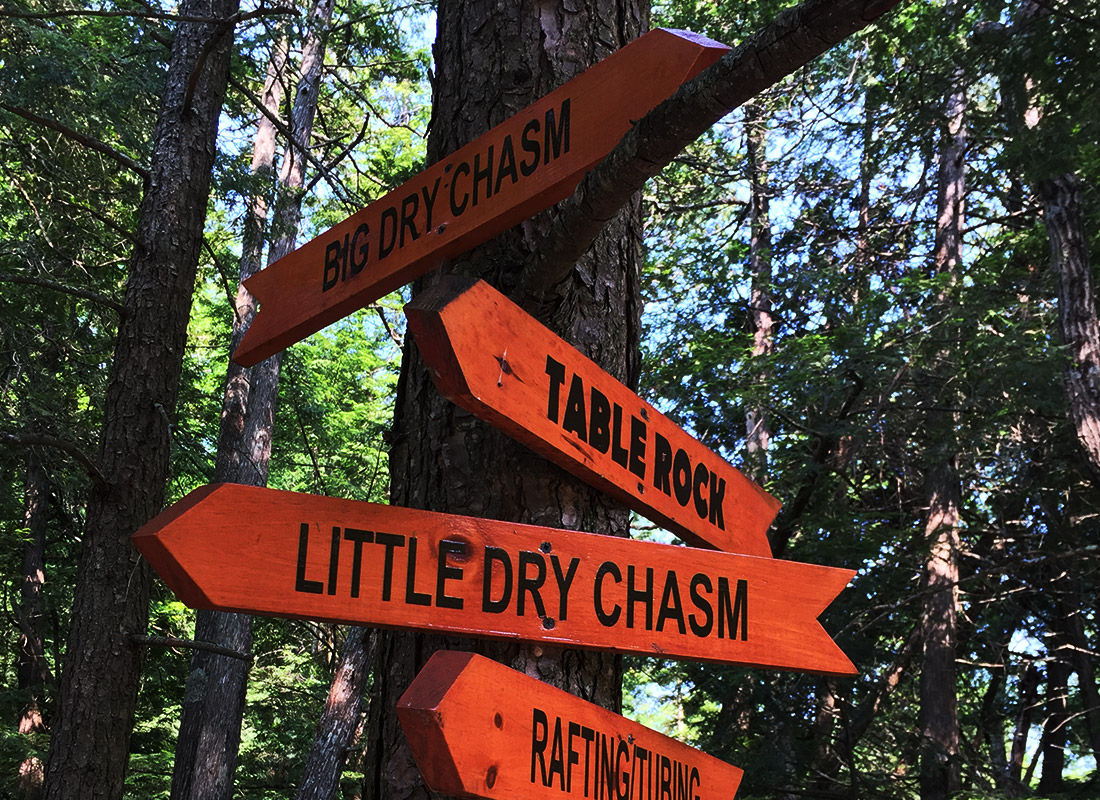
Trail markers are high enough on trees so as to be out of sight level, until you look for them ever by tilting your head ever so slightly upward and they are there. But it is you that is breaking the spell. You chose to reaffirm your presence on the trail.
This is why most trail shelters have 3 walls, not 4.
While it may seem tempting to provide more on trail luxury, it is not a wise practice. The trail designers are getting it right! In fact, there are places that provide such amenities. They are called towns and cities, and most hikers hit the trail to escape them, not import their conveniences.
It would be easy to manage a few more simple amenities in the average shelter or campsite. Hey, why not add a fourth shelter wall to really keep the weather out? And what about a woodstove? If we had a windmill we could charge our devices. A dryer would help us dry our clothes… The problem is, it’s hard to know where to stop. Escalators? And while it may be a touchy subject for some, there is a balance to be made between safety and amenity that does not make shelters appealing for long term stays. Overdoing a shelter tempts people to move right in and hang their hat full time. We all may be sympathetic to the homeless, but shelter squatting is probably not the ideal solution.
Nature bites back. The most essential ingredient in trail maintenance is a steady stream of hikers. Without a regular supply of feet and shoulders to trample and generally discourage aspiring vegetation any hiking trail will be consumed by its surroundings in a very short time.
As we walk through the woods, it’s easy to think that our presence went unnoticed. It almost was. But every footstep, every brush of the vegetation on your arm is another small discouragement that replaces nature and goes a tiny way toward maintaining the trail for those who will follow. If we really and truly “left no trace” the trail would vanish.
Without our collective plodding, the work of the trail maintainer would be arduous and discouraging. Maintainers clear the more serious hazards that clog the trail. But they also coax and encourage hikers where to step in order to do the least damage to the trail. Minimalism is always a goal, both by design and by necessity.
I’ve hiked a lot of marginalized trails in Quebec, and underused paths are hard to hike and even harder to maintain. Andrew Skurka noted on his Sea-toSea Route trek that the International Appalachian Trail portions in Quebec are hardly a trail at all. He struggled to stay on trail in thick bush as the forest reclaimed the thin path back into nature’s chaotic fold. This portion of his adventure offered some of the toughest challenges.
It can be stressful to hike a vanishing trail. Without a clearly defined footpath of trampled vegetation, hikers must pay close attention to every blaze. Navigation soon becomes a full time task, reducing the enjoyment of the outing and further hastening a trail’s demise.
Trailheads look inviting with wide paths to beckon would be hikers into the woods. But after a hundreds yards or more the trail is reduced to its most minimal form. You are gently eased out of civilization until you are getting by with as little of it as possible. It is what you asked for. It is what most hikers want.
Any trail on a mountain peak requires careful consideration of the fragile vegetation that has only a marginal foothold on life in a harsh locale. The trail must be limited to protect the arctic lychens, mosses or wildflowers, but if the route is too restrictive hikers will cheat and sneak off trail for panoramic photos or just to catch a glimpse of an amazing valley floor. Some access must be granted, and the terrain we hikers need to traverse is sacrificed to preserve the rest of the peak’s fragile ecosystem. This balance of permission versus restriction must be carefully considered in advance, as much of the vegetation at altitude takes years to recover if it does at all. Unlike at lower altitudes, a trail blazed on the peak will likely not be reclaimed by nature for decades. Careful design of these routes is essential.
There are numerous river fords in the Maine portion of the Appalachian trail. Probably the state featuring the most minimalist approach to trail design, Maine has opted to force through hikers to wade almost waist high in several water crossings in what is unquestionably the most state with the most remote sections on the AT. The other 13 states provide bridges to keep hikers feet somewhat dry. Maine has opted for a more natural experience.
For northbounders, it is a opportunity to apply lessons learned in the first 1900 miles of hiking. For southbounders, it is a sudden wake-up call that you are far from the cozy couch you left only days ago.
The Maine approach has worked for decades, but the 2023 Class of AT thru-hikers found themselves confronting higher than normal level of precipitation and the swollen rivers that the rains bring. With climate change bringing less predictable weather worldwide, it may be time for Maine to think about bridging these rivers before a tragedy occurs. Of course, this task won’t be easy. Materials must be brought to remote locations on trail and workers must stay there to build the bridge. Hiking always comes with risks, but the Maine fords are shaping up to an unacceptably high risk for a major national scenic trail like the AT.
Today, the focus is on designing more sustainable trails which have a less impact on their surroundings and require lower maintenance. Ideally, a trail should skirt the side of a hill and allow water to run across it. If water cannot cross a trail it will follow along it. This leads to a wet trail which erodes quickly and lessens a hikers footing. This is good for neither the trail nor the hikers who use it.
The AT was blazed in the 1930’s, long before the word ‘sustainable’ meant anything more than how long a singer might hold the same note. Much of the trail is built sustainably. Much of it is not. There are many fall line ascents (especially in New England) which become streams in a heavy rain.
The original pathfinders were looking for the fastest way to the top and were less concerned about planning a route to support myriads of hikers in perpetuity. The AT linked in to these local mountain ascents and brought more traffic than those originally blazing trails ever dreamed would use them. Time and population increases have only amplified the issue.
Bit by bit the AT undergoes reroutes to more sustainably designed trails that do not simply race to the peak against the current of the water racing to the valleys below. Of course, all of this will add miles to an already lengthy trek, but will make the trail more gradual and more durable. It’s only a matter of time.
Copyright © 2024 All rights reserved
 Rushbrooke Adventure